
For most college football players, the road to Division I begins with scholarship offers straight out of high school. For Sean Farfan, that road started somewhere less visible, which was the junior college fields of Southern California.
Farfan, a Latino athlete who began his collegiate career at Mount San Antonio College, worked his way through the junior college system before earning an opportunity to play Division I football at Northern Arizona University. His journey reflects a path taken by many athletes who are overlooked during high school recruiting but continue to develop through junior college programs.
“Out of high school recruiting was pretty slow,” Farfan said. “I didn’t have any division I offers apart from some NAIA and division 2 interest but not an official offer.”
Now, Farfan’s story represents more than just athletic achievement. It highlights the role of California’s junior college pipeline in creating opportunities for Latino athletes and underscores the persistence, family support, and cultural identity that often shape their journeys. For many Latino families, access to recruiting networks and exposure can be limited, making alternative pathways like junior college especially important.
Instead of stepping away from the sport, Farfan chose to continue his career at Mount San Antonio College, Where every practice and game carries added importance and not just for team success, but for the chance to be noticed.
“The biggest challenge about going through the JUCO route is honestly the motivation to keep going,” Farfan said. “When it comes to playing junior college everything is your decision, you aren’t getting paid to go there the only benefit to you is that you are given a platform and opportunity to play and get film and hopefully get help to get to that next level.”
The junior college experience is often defined by uncertainty. Limited resources, constant competition, and pressure to perform make it one of the most demanding paths in college athletics. For Farfan, it became a proving ground where discipline and consistency set him apart.
That discipline did not go unnoticed.
“Sean was one of the most disciplined players I’ve been around,” a former teammate said. “He never skipped drills and he kept everyone in our specialist group accountable.”
His leadership extended far beyond performance. Teammates described him as someone who held others to the same standard he set for himself.
“He was honest when we weren’t doing something right and never afraid to stand up for himself,” the teammate said. “He knew he was good but never bragged about it. He was confident and steady, never letting good or bad moments affect him.”
Those closest to him saw that consistently off the field as well.
“Watching him train and work hard towards his goals made me proud to call him my partner,” his girlfriend of six years Hanna Conchas states. “I was always so impressed with his work ethic. Waking up at 5 a.m. every day, going to practices and lifts, sticking to diet plans, and carrying a full load of classes.”
That level of commitment eventually led to his opportunity at Northern Arizona University which validated years worth of work that went unseen.
Farfan, being as determined as he is, took his recruiting into his own hands and reached out to many division 1 schools and actually ended up reaching out to Northern Arizona University himself.
“My last hope was reaching out to a former coach I had and asking if he had known of any division 1 schools that were looking for a long snapper and he got back to me and said that NAU was looking for one and he sent me the head coaches number,” Farfan said. “I texted the head coach and sent him my film and within 10 minutes he got back to me and said if I could be in Northern Arizona by next month.”
Everything moved very fast for Farfan as within that month he went up to Northern Arizona to discuss scholarship among other things and had officially been offered to play division 1 football at Northern Arizona University.
For many latino athletes in California, Farfan’s journey reflects a border reality. Recruiting opportunities can be limited, and junior college often becomes a critical pathway to continue pursuing the sport. Stories like his provide representation and serve as a reminder that success is possible, even when the path is less traditional.
“For latinos I was a representation that you can do it,” Farfan said. “I had heard the stigma that it is harder for latinos to make a college program especially playing college football and I am sure that in the past there is kids overlooked because of their race and it is not a valid thing but if you let that get to you when you are trying to train and want to follow your dream than you have already lost that battle”
Farfan’s journey has also been shaped by family and community values that are often central within Latino culture. Those influences helped keep him grounded throughout the process and continue to guide him as he moves forward.
Today, his impact extends beyond football.
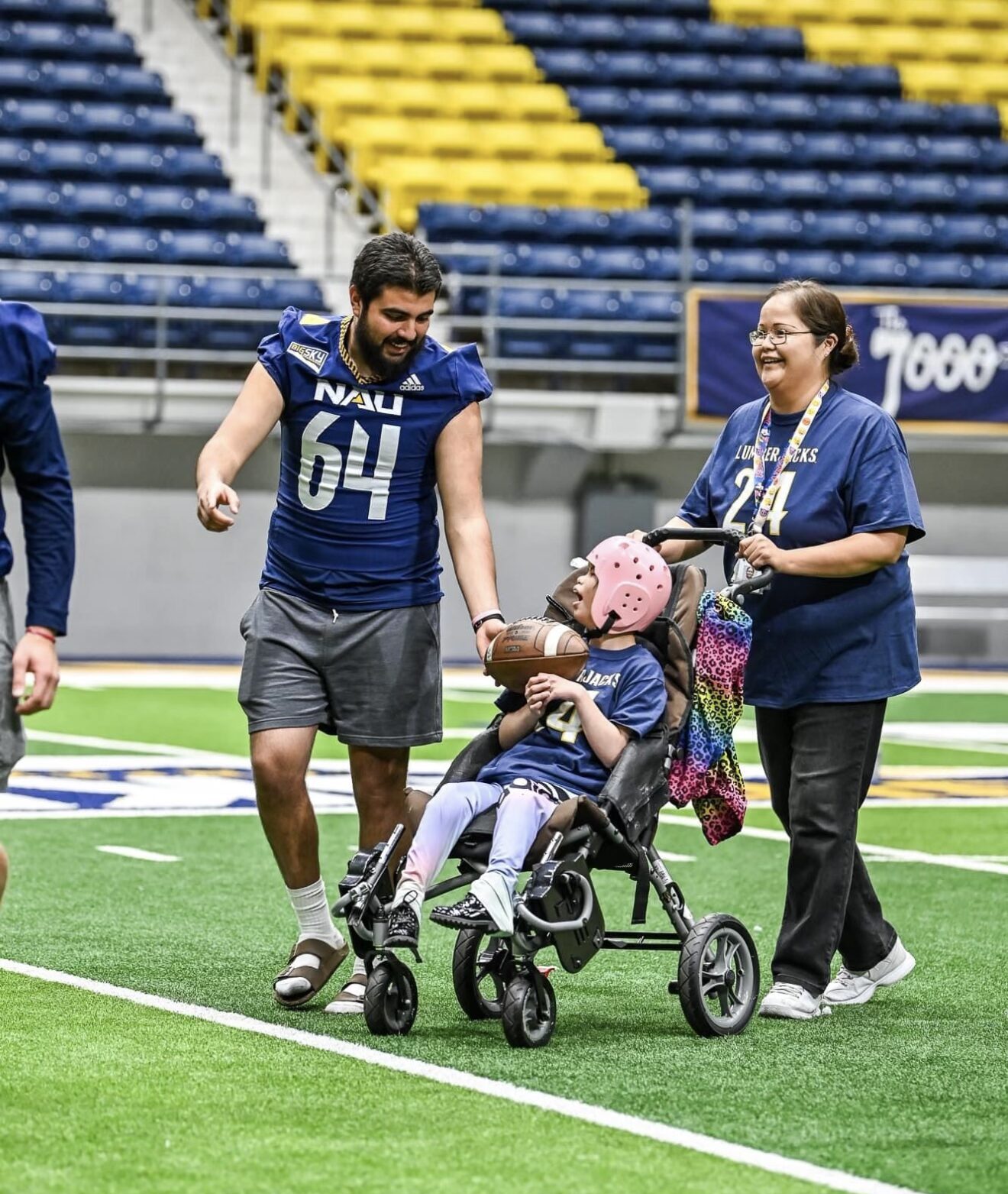
Farfan now works with special education students at a school, taking on a role that reflects the same leadership and patience he showed as a player.
“What led me to accept this job was while at NAU we did this thing called Victory day and basically that’s where one of the local high schools bring their special education students and they get to just hang out with the football players,” Farfan said. “ It was honestly such a humbling and fun time. We were just having a good time doing football drills and hanging out. Seeing their excitement made me really happy so when I got the opportunity to work with special education and be a part of that community again I was more than happy to jump on it.”
In many ways, the transition mirrors the mentorship he provided to teammates.
“What stood out most was how he constantly supported others, always checking in to make sure everyone was okay,” his former teammate said.
That same mindset now shapes how he interacts with students, offering guidance and encouragement in a different setting.
As conversations around access and representation in college athletics continue, Farfan’s story highlights the importance of alternative pathways like the junior college programs. His journey from Mount SAC to Northern Arizona University illustrates both the challenges of that path and its overall potential.
For young athletes from similar backgrounds, his story sends a clear message: the route may not always be direct or straight forward but persistence, discipline, and belief can still lead to opportunity.
Gabriel Angulo is a journalism graduate from California State University, Long Beach, where he majored in journalism. He also worked as a reporter for ENYE, the university’s bilingual magazine. After graduating, he plans to continue writing and reporting, with a particular interest in sports journalism.